
THREE HUNDRED MILLISECONDS 3/3
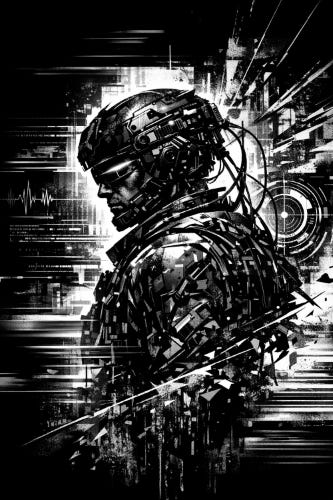
[ Index ] [ 1/3 ] [ 2/3 ] [ 3/3 ]
Mirror Match
Irving knew it was a soldier the moment the breach began correcting for him.
The first anomaly hit the predictive trading engine, an injected volatility spike that adjusted itself mid‑execution, learning as fast as the countermeasures. That didn’t come from criminals or analysts.
That came from someone trained to fight live.
“Cross‑corp engagement,” Irving said, “Human‑in‑the‑loop.”
The Ops Pod tightened. Neural-assist came online at reduced autonomy, corporate policy after the ransomware incident. Irving accepted the lag.
The opposing signal resolved into a signature he recognized.
Callsign: K‑Frame.
Former global eSports champion. Retired at twenty‑six. Reappeared eighteen months later on a rival megacorp’s Black contract with machine‑augmented reflexes that outpaced baseline cognition.
Irving had studied him. Everyone had.
K‑Frame didn’t just anticipate opponents. He forced them into errors by accelerating decision tempo past comfort thresholds.
The trading engine shuddered.
False demand signals rippled outward, triggering automated procurement. Supply chains flinched. Markets interpreted the noise as intent.
Irving injected damping algorithms.
K‑Frame countered with timing distortion, less volume, more precision. Probing Irving’s reflex ceiling.
“You’re late,” K‑Frame said, patching in uninvited.
Clean signal. No spoofing.
Irving didn’t respond.
He split his attention: one thread stabilizing markets, another mapping K‑Frame’s adjustments. Elegant. Controlled. Faster implants.
Irving deployed adversarial inputs, synthetic consumer behavior designed to confuse upstream predictors.
K‑Frame absorbed them, discarded the noise, adapted.
“You’re still playing defense,” he said, “That’s why they’ll replace you.”
The engines spiked. A cascade formed, perception feeding reality. If it matured, regulators would intervene. Emergency authorities would expand. Surveillance justifications would fall into place like dominoes.
Irving saw the path to victory.
A recursive signal loop. Self‑reinforcing. Guaranteed to force a market halt. Brief. Contained. Enough damage to justify permanent authority expansion.
The system highlighted it:
Recommended Action, High Confidence Success
The AI supervisor began pre‑arming the command.
Irving canceled it.
For the first time, K‑Frame hesitated.
“You see it,” he said, “Take it.”
Irving ran the numbers again. The loop would work. Clean. Irrefutable. The corporation would gain unprecedented visibility. Behavioral compliance baked into infrastructure.
No more ransomware surprises. No more unknown risks.
“You don’t have to be the hero,” K‑Frame said, “You just have to be fast.”
Irving’s hands moved into position.
The moment arrived, the frame window where execution determined the outcome.
He waited.
Three hundred milliseconds.
The supervisor AI surged, trying to seize control. Irving burned his override authorization, forcing manual dominance.
The loop collapsed unused.
The cascade destabilized but didn’t converge. Markets wobbled instead of breaking. Regulators paused. Emergency protocols failed to justify themselves.
K‑Frame laughed, once, sharply, “You passed.”
He withdrew, severing attack vectors with surgical precision. No pursuit window. No retaliation path.
The system rushed to fill the gap, automated explanations, sanitized reports, volatility smoothing. Crisis downgraded to anomaly.
Metrics populated:
Engagement Result: Inconclusive
Response Efficiency: 92.1%
Decision Latency: Exceeded Optimal Window
Override Usage: Excessive
Behavioral Note: Ethical Interference Detected
Ops broke silence, “Why didn’t you take the shot?”
Irving’s breathing stayed steady, “It would’ve solved the wrong problem.”
“That wasn’t the question.”
Irving disengaged. The harness clicked open.
Outside, systems stabilized. Life moved on.
Inside his inbox, a review notice queued itself:
Performance Evaluation, Immediate
Irving didn’t open it.
He stood in the quiet after machine combat, knowing K‑Frame would be back, faster next time, and knowing the system wouldn’t hesitate for him.
After Action
The evaluation arrived forty‑eight hours later.
No meeting. No call. Just a document appended to his profile, classification “Routine,” priority downgraded to administrative. The language was precise enough to feel merciful.
“Subject demonstrated high technical proficiency under competitive pressure.”
“Subject exhibited delayed execution due to discretionary judgment.”
“Risk tolerance variance noted.”
His suitability score fell below the renewal line by a point.
Irving read it once. He didn’t contest it. Appeals generated conversations, and conversations generated records. He closed the file and let the system register compliance.
The Ops Pod reassigned itself the same day.
A younger soldier took his slot, faster EEG curve, cleaner behavioral profile. Irving watched the handover from the observation deck, anonymous behind privacy glass while the Pod adjusted to a new spine, a new pulse.
The system didn’t miss him. It rebalanced.
Outside, the city continued as designed: commuters optimizing routes, markets correcting micro‑inefficiencies, devices synchronizing without awareness of the violence they were built on. The ransomware event faded into quarterly summaries. The market anomaly became a footnote.
No new authority expansions were announced. That absence wasn’t noted anywhere.
Irving cleared his locker. Two changes of clothes. Old tournament credentials. An expired neural patch.
As he signed his exit acknowledgments, a message arrived on his personal channel.
No corporate header. No encryption badge.
Just text:
Next time, don’t hesitate.
- K
Irving stared at it until the system flagged inactivity.
He didn’t reply.
He powered down his implants manually, accepting the nausea as the world slowed to human speed. It felt imprecise. It felt real.
When he stepped outside, the city didn’t recognize him as a soldier.
He preferred that.
Behind him, the corporation continued budgeting risk, shaping loss, refining soldiers who would never wait three hundred milliseconds.
Somewhere ahead, data would still be contested. Markets fought at machine speed. Another frame always arriving.
Irving walked on, carrying the one thing the system had never learned to price:
Delay.
And the knowledge of when it mattered.
Bravo!