
THREE HUNDRED MILLISECONDS 2/3
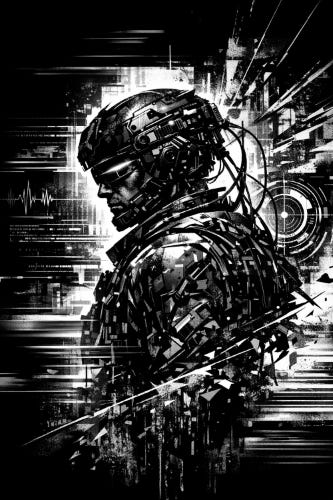
[ Index ] [ 1/3 ] [ 2/3 ] [ 3/3 ]
Criminal Containment
The first alert didn’t trip an alarm.
It registered as a one‑byte checksum mismatch in a logistics system in Rotterdam, self‑corrected, auto‑ignored. Irving flagged it Yellow because he was already watching entropy drift across the fleet.
Thirty seconds later, payroll in São Paulo went dark.
He leaned forward. The harness tightened around him.
“Correlation.”
His display bloomed with authentication failures, valid certificates, trusted binaries, supply‑chain residue.
“Time to impact?” Ops asked.
Irving ran the projection, “Two minutes. Global.”
A ransom message appeared on an executive dashboard in Zurich:
YOUR BUSINESS CONTINUES WITH OUR PERMISSION.
The malware didn’t just encrypt. It severed trust paths. Backups mounted clean and useless.
Irving dropped to manual.
“Kill‑zones. Level‑Three.”
Legal protested. Irving overrode with his rank token.
Network segmentation slammed down like blast doors. Regions vanished from his map. The malware raged inside sealed compartments, starving.
He’d bought time. At a price.
Customer support feeds spooled in one corner of his display, audio suppressed, waveform only. Hundreds of calls. Flatlines where systems dropped. Payroll outages. Clinic failures. Logistics stalls.
“Decrypt path?” Ops asked.
“None,” Irving said. “They didn’t build one.”
The ransomware wasn’t persistent. It burned itself out after detonation, silent, locked files, no beaconing, no command‑and‑control.
“They want pressure, not negotiation.”
A second message appeared, addressed to the board:
YOU HAVE 24 HOURS. FAILURE RESULTS IN DATA DESTRUCTION AND CONTROLLED RELEASE.
Legal repeated the word questioningly “Controlled?”
Irving found the answer.
The payload had mapped data by business sensitivity and regulatory exposure. Not a dump. A controlled release of precision leaks. Fines. Lawsuits. Executive exits.
A scalpel, not a bomb.
“They know where it hurts.”
He ran a counter‑encryption sim. It collapsed instantly. Keys never persisted. Designed that way.
Ops asked for options.
Irving highlighted three:
Pay the ransom.
Rebuild from scratch.
Partial restore, accept losses.
He deleted the first one. No guarantee the criminals would honor the bargain.
Number two would take weeks. Fatal.
He hovered over option three.
A junior analyst broke protocol.
“Sir, we might be able to shim payroll, ”
“Negative. Any reconnection reintroduces the attack surface.”
“But people will lose…”
“I know.”
He executed option three.
Selective restoration began, core IP, ledgers, executive comms. Everything else stayed dark. Integrity checks passed. Green indicators spread.
The countdown continued.
“Status?” the board demanded.
“Containment achieved. Critical assets secured.”
“And the ransom?”
Irving watched the São Paulo node time out. Another waveform flattened.
“No payment.”
Silence.
The attackers waited. Pressure matures best when left alone.
At T‑minus six hours, a sample leak hit the wild: curated emails, minor but damaging. Enough to show intent. Not enough to force panic.
Irving tracked dissemination vectors, flagged amplification nodes, adjusted counter‑narratives. PR deployed statements. Stock dipped, stabilized, dipped again.
At T‑minus one hour, escalation.
The attackers began corrupting data inside quarantines, poisoned ledgers, subtle discrepancies, long‑term damage.
Ops didn’t specify the command but Irving knew what they meant.
“Do it.”
Irving terminated the quarantined regions entirely.
Power draw dropped. Network noise vanished. Thousands of endpoints went permanently dark.
The ransom timer hit zero.
Nothing happened.
The attackers had planned for panic. They had not planned for amputation.
Forensics confirmed it hours later. The ransomware was dead. No reinfection. No residual vectors. The cost was absolute but bounded.
The board reconvened.
“Well handled,” someone said, “Shareholder impact minimal.”
A new metric appeared:
Human Disruption Index: Elevated but Acceptable
Irving stared at the message hard. Disruption. Acceptable.
When he disengaged, the Pod released him slowly. Outside, the city continued the daily grind. Systems he didn’t control continued to function.
Inside his inbox, a message waited:
My dad’s check didn’t clear. Just so you know.
Irving marked it as received, but didn’t reply.
The system logged the incident as Contained.
He didn’t correct it.
Known Risk
Irving didn’t find the mole by looking for theft.
No outbound spikes.
No DNS beacons.
No credential misuse.
Dashboards were clean, too clean. Every alert cleared thresholds. Every audit passed.
That was the problem.
He’d been tracking access timing since the ransomware event. Micro‑patterns. Humans drift. Machines don’t.
One account didn’t drift.
Architect‑level clearance.
Read‑only access level..
Accessing core systems at 0417, 0419, 0421.
Three times a week.
Fourteen months.
Always early.Never late.Regular as clockwork.
Irving pulled the biometric overlay. Heart rate low. Cortisol flat. Too flat.
He tagged it:
Behavioral Anomaly, Level‑Two
The system asked if he wanted to escalate.
He didn’t answer.
He initiated a shadow trace.
The architect wasn’t extracting data. He was sampling it, tiny fragments, immediately discarded. Harmless to anyone who didn’t know what to look for.
Irving knew.
Entropy harvesting.
You didn’t steal files.
You stole the shape of them.
He followed the trace outward, not to an external IP, but to absences.
He cross‑referenced market events.
The alignment was clean.
He stood up from the Pod. Protocol flag. No challenge.
He moved through security.The architect’s office was unchanged.
Irving didn’t knock.
The architect looked up, smiling.
“I wondered when you’d notice.”
“Hands.”
The man, older, calm, complied.
“You’re extracting system behavior,” Irving said.
“You always were fast.”
“Who’s paying you?”
“No one who wants your files.”
“You’re selling vulnerabilities.”
“Probabilities,” the architect corrected,“There’s a difference.”
Irving projected the trace.
“You’ve been doing this for over a year.”
“And you only caught it because ransomware forced you sideways.”
“Why?”
The architect leaned back.
“Because if everyone believes the system is invulnerable, someone will prove it isn’t. Catastrophically. I make sure the damage stays priced in.”
“You’re destabilizing us.”
“No. I’m stabilizing the market.”
Irving felt something cold creep down his spine and fill his ribcage.
“You knew.”
“I suspected.”
“You let it happen.”
“I allowed it to be survivable.”
Irving opened a Tier‑Black channel, Legal, Oversight, Risk.
Gray. No replies.
The architect watched him try again.
“Tier‑Black logs initiations,” he said, “Not conversations.”
Irving checked.
Acknowledged. Nothing else.
“You’re a known risk.”
“That’s the term.”
“Then why keep you?”
“Because you’re not defending data,” the architect said, “You’re shaping losses. So am I.”
Irving terminated the trace.
“Stand.”
The architect stood.
“What happens now?”
A system message appeared:
INVESTIGATION CLOSED, NO ACTION REQUIRED
Irving dismissed it.
“You continue. Within parameters.”
“Good hunting, Sergeant.”
As Irving walked back, a new flag appeared:
Behavioral Deviation, Investigator Hesitation
He acknowledged it.
Back in the Pod, he ran a self‑diagnostic.
Everything passed. That bothered him more than if it hadn’t.
This is pretty cool man!